| Description | Participants | Summaries | Products |
|---|
Archived NIMBioS Working Group
Species Delimitation
Topic: Biological, computational, and mathematical problems in gene tree-based species delimitations
Organizers:
David Weisrock
(Dept. of Biology, Univ. of Kentucky);
Ruriko Yoshida (Dept. of Statistics, Univ. of Kentucky)
Meeting dates: December 2-4, 2010; September 22-24, 2011
Project summary: Modern biological study is increasingly being pursued through synergistic collaborations between biology and higher mathematics. Important connections are beiing established between computational evolutionary biology and the emerging field of "algebraic statistics," which combines combinatorics, computational algebra, polyhedral geometry and statistical modeling. The primary objective of this working group is to bring together new and established researchers in mathematics, biology, and statistics in order to discuss challenges in a growing field that applies gene trees reconstructed from DNA sequence data to delimiting species. Identifying species is a fundamental task in biological study. However, mathematical and computational challenges remain in the application of genealogical criteria to species delimitation. Many of these limitations are interrelated with each other. Consequently, it is very important that researchers in mathematics, statistics, and the life sciences work together to overcome these challenges. In this working group, we will highlight and work on what we see as the major challenges that would benefit from an integrated research approach across the biological and mathematical sciences.
Meeting Summaries
| Mtg # | Dates | Agenda | Summary | Photo | Evaluation |
|---|---|---|---|---|---|
| 1 | Dec 2-4, 2010 | Link | Link | Report | |
| 2 | Sep 22-24, 2011 | Link | Link | Report |
Meeting 1 Summary. Three main topics or questions to serve as the current focus of the group were identified. First, there is a need to understand the relative performance of many genetically-based species delimitation methods under a range of evolutionary scenarios. A series of simulation studies is being developed to address this issue. This work is intended to serve as the basis of a major review paper and will guide further methodological development. Second, discussions often returned to the question of "What is it that we are delimiting?" particularly in terms of how existing and new methods are approached. Third, there was a strong desire to expand upon the existing framework that guides species delimitation. Breakout sessions led to a number of ideas that will be the source of continued work, including models that can account for non-neutral loci or models that can simultaneously consider many forms of data, including genetics, geography and morphology.
Meeting 2 Summary. The second meeting was used to update the larger group with the developments of two projects that arose as a product of the first working group meeting, and discuss their continued work. One of these projects is a simulation study to evaluate the performance of different species delimitation methods. The second project involves the development of a Bayesian method that will use both genetic and non-genetic information to perform species delimitation. This meeting included some new members that were not able to participate in the first meeting, two of whom are the developers of a recent Bayesian species delimitation approach. Considerable time was spent discussing computational and statistical issues related to this approach. In addition, topics that arose at the first meeting continued to be interlaced into the discussion of these issues, including how to best deal with non-neutral data, and how we can discriminate between delimiting differentiated populations and delimiting species. Different subsets of the working group will actively work on the simulation and Bayesian projects in the time leading up to the 3rd meeting, which is planned for September 2012.
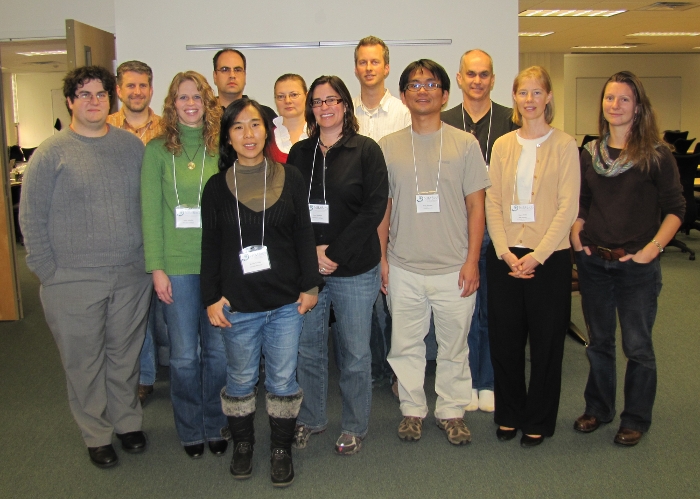 |
| Meeting 1 participants (Back row, L to R): Weisrock, D. Carstens, J. Chifman, A. Leache; B. Shaffer. (Front row, L to R): B. O'Meara, L. Kubatko, R. Yoshida, L. Knowles, T. Jhwueng, S. Smith, C. Ane. |
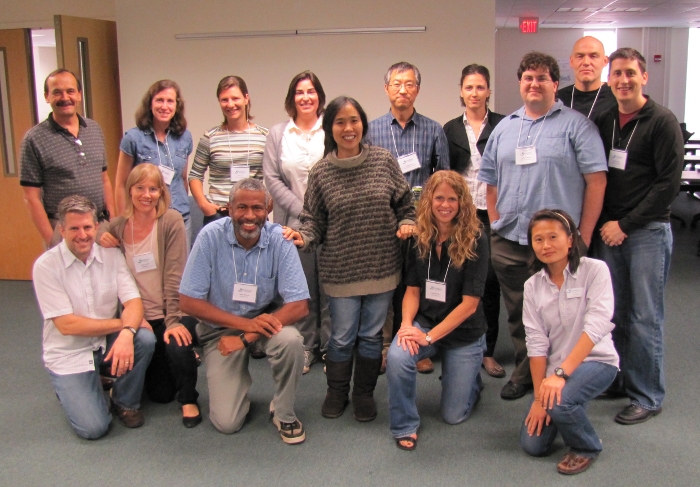 |
| Meeting 2 participants (Back row, L to R): G. Stuart, E. Allman, C. Ane, L. Knowles, Z. Yang, S. Petrovic, B. O'Meara, B. Rannala, D. Haws. (Front row, L to R): D. Weisrock, S. Smith, S. Edwards, R. Yoshida, L. Kubatko, J. Chai |
NIMBioS Working Groups are chosen to focus on major scientific questions at the interface between biology and mathematics. NIMBioS is particularly interested in questions that integrate diverse fields, require synthesis at multiple scales, and/or make use of or require development of new mathematical/computational approaches. NIMBioS Working Groups are relatively small (up to 10 participants), focus on a well-defined topic, and have well-defined goals and metrics of success. Working Groups will meet up to 3 times over a two-year period, with each meeting lasting up to 2.5 days.
A goal of NIMBioS is to enhance the cadre of researchers capable of interdisciplinary efforts across mathematics and biology. As part of this goal, NIMBioS is committed to promoting diversity in all its activities. Diversity is considered in all its aspects, social and scientific, including gender, ethnicity, scientific field, career stage, geography and type of home institution. Questions regarding diversity issues should be directed to diversity@nimbios.org. You can read more about our Diversity Plan on our NIMBioS Policies web page. The NIMBioS building is fully handicapped accessible.
NIMBioS
1122 Volunteer Blvd., Suite 106
University of Tennessee
Knoxville,
TN 37996-3410
PH: (865) 974-9334
FAX: (865) 974-9461
Contact NIMBioS