| Description | Participants | Summaries | Products |
|---|
Archived NIMBioS Working Group
Modeling Forest Insects
Topic: Synthesizing predictive modeling of forest insect dynamics across spatial and temporal scales
Organizers:
Mario Pineda-Krch (Centre for Mathematical Biology, Dept. of Mathematical and Statistical Sciences, Univ. of Alberta, Canada)
Mark Lewis (Centre for Mathematical Biology, Dept. of Mathematical and Statistical Sciences, Univ. of Alberta, Canada)
Andrew Liebhold (Northern Research Station, USDA Forest Service)
Meeting dates: Feb 22-26, 2010; Oct 18-21, 2010; Apr 14-20, 2011; Oct 13-17, 2011
Project summary: In many parts of the world forests are experiencing an unprecedented onslaught of outbreaks by destructive forest insects, e.g. massive pine beetle outbreaks and continuing large scale range expansions of Gypsy moth in North America and Europe. There is a long history of quantitative modeling of forest pests aimed at increasing our ability to predict outbreaks. This working group will bring together an inter-disciplinary group of researchers with expertise in quantitative approaches for studying forest insect pest populations, global climate change scenarios, forest fire dynamics, and evolutionary dynamics of antagonistic ecological interactions. The aim of the working group is to synthesize cutting edge predictive modeling approaches using several case studies for which data on historical outbreaks are available. We have identified a group of leading researchers engaged in developing an understanding of the complex ecological, evolutionary, and environmental processes governing the dynamics of forest insect pest. Using the resources at NIMBioS, we plan to bring these experts together to advance our forest insect population modeling capabilities.
Four meetings are planned, each focusing on a specific theme with invited thematic experts. The meetings will focus on synergistic activities promoting the synthesis of existing quantitative approaches as well as the development of novel modeling approaches. Mathematical, statistical, and computational methods will be used and implemented using case studies based on historical outbreak data of e.g. mountain pine beetle, gypsy moth.
Meeting Summaries
| Mtg # | Dates | Agenda | Summary | Photo | Evaluation |
|---|---|---|---|---|---|
| 1 | Feb 22-26, 2010 | Link | Link | Report | |
| 2 | Oct 18-21, 2010 | Link | Link | Report | |
| 3 | Apr 14-20, 2011 | Link | Link | ||
| 4 | Oct 13-17, 2011 | Link | Link | Report |
Meeting 1 Summary. During the first meeting, key research needs to improve our understanding of the dynamics and management of forest insect pests, particularly in light of anthropomorphic environmental changes such as climate change and habitat fragmentation, were identified. Sub-groups were formed to address one or several inter-related questions, including the role of environmental factors and spatial structure in driving forest insect dynamics, the role of ecological interactions resulting in or arising from insect outbreaks, and how to optimally predict and control outbreaks. Results from each subgroup's work will be published in peer-reviewed publications. The discussions during the first meeting and the ideas that emerged have provided a solid foundation for the future work of the group. The next meeting is scheduled for October 2010.
Meeting 2 Summary: The second meeting of the working group started with progress reports on the various sub-projects identified in the first meeting, including updates on the available data sets. Projects that showed particular promise were identified, and the group decided to focus its efforts on these. The projects address a wide range of questions, some focusing on specific species (e.g. bark beetle, gypsy moth and spruce bud worm) while others are more general. Examples of questions being addressed are the role of spatial configuration, environmental gradients, and ecological interactions on population dynamics of forest insects and the ecological and evolutionary response of populations to different scenarios of global climate change. Breakout groups focused on refining models and laying the groundwork for manuscripts. The overarching theme emerging in several of the projects was the development of simpler models than what initially was envisioned with the aim of systematically adding complexity once the simple model is well understood. On the last day of the meeting each sub-group reported back to the whole group and provided progress updates and outlined the goals for the next meeting. For at least one of the projects, the aim is to write a manuscript for the next meeting while in other groups the aim is to explore the models, obtain results and perform analyses. We also discussed the co-authorship philosophy of the group.
Meeting 3 Summary: The third meeting of the working group consisted primarily of independent work by the sub-groups focusing on the various projects. Regrettably a large number of participants were not able to participate in the meeting in person. All of the following participants either participated in the last meeting remotely or have confirmed that they are still committed to continue their participation in the working group: Barbara Bentz (Entomology, USDA Forest Service); Barry Cooke (Biodiversity and Entomology, Canadian Forest Service); Kyle Haynes (Environmental Sciences, Univ. of Virginia); Anthony Ives (Zoology, Univ. of Wisconsin); Patrick James (Biological Sciences, Univ. of Alberta); Subhash Lele (Mathematical and Statistical Sciences, Univ. of Alberta); Mark Lewis (Biological Sciences, Univ. of Alberta); Mario Pineda-Krch (Ecology & Evolution, Univ. of Alberta). One day was spent in a whole-group meeting providing progress updates on the five projects that are pursued by the group, i.e. (1) a deterministic ecological model of bark beetle and tree dynamics; (2) a simulation model addressing the role of landscape configuration on forest insect population dynamics; (3) evaluation of optimal control of outbreaks; (4) a deterministic ecological model addressing the role of tritrophic ecological interaction on spruce budworm population cycles; (5) a quantitative genetic model addressing the evolution of cold tolerance in bark beetles. Two new participants joined the working group, Suzanne Lenhart and Vlastimil Krivan. Most of the projects are at a stage now where manuscripts are starting to take place. For the next meeting of the working group, which is scheduled for October, we are aiming to have manuscript drafts written for several of the projects.
Meeting 4 Summary: The fourth meeting consisted primarily of break-out meetings of the sub-groups with only brief whole group meetings on the first and last day of the meeting. Part of the meeting took place at the University of Tennessee Biology Field Station in the Great Smoky Mountains National Park. The focus of the working group was on the following five specific projects: (1) a deterministic ecological model of bark beetle and tree dynamics; (2) a simulation model addressing the role of landscape configuration on forest insect population dynamics; (3) evaluation of optimal control of outbreaks; (4) a deterministic ecological model addressing the role of tritrophic ecological interaction on spruce budworm population cycles; and (5) a quantitative genetic model addressing the evolution of cold tolerance in bark beetles. Several of the projects are at a stage now where manuscripts are either in progress or being finalized.
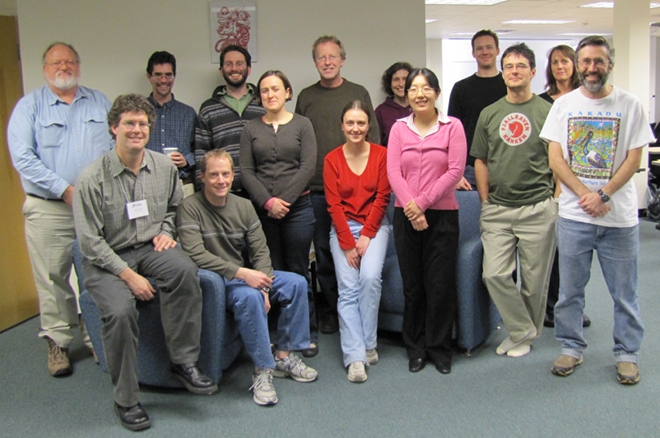 |
| Meeting 1 participants (Back row, from left) Tom Swetnam, Barry Cooke, William Godsoe, Andrew Liebhold, Christina Cobbold, Patrick James, Barbara Bentz (Front row, from left) Mark Lewis, Kyle Haynes, Josie Hughes, Sharon Bewick, Xi Yang, Mario Pineda-Krch, Greg Dwyer |
NIMBioS Working Groups are chosen to focus on major scientific questions at the interface between biology and mathematics. NIMBioS is particularly interested in questions that integrate diverse fields, require synthesis at multiple scales, and/or make use of or require development of new mathematical/computational approaches. NIMBioS Working Groups are relatively small (up to 10 participants), focus on a well-defined topic, and have well-defined goals and metrics of success. Working Groups will meet up to 3 times over a two-year period, with each meeting lasting up to 2.5 days.
A goal of NIMBioS is to enhance the cadre of researchers capable of interdisciplinary efforts across mathematics and biology. As part of this goal, NIMBioS is committed to promoting diversity in all its activities. Diversity is considered in all its aspects, social and scientific, including gender, ethnicity, scientific field, career stage, geography and type of home institution. Questions regarding diversity issues should be directed to diversity@nimbios.org. You can read more about our Diversity Plan on our NIMBioS Policies web page. The NIMBioS building is fully handicapped accessible.
NIMBioS
1122 Volunteer Blvd., Suite 106
University of Tennessee
Knoxville,
TN 37996-3410
PH: (865) 974-9334
FAX: (865) 974-9461
Contact NIMBioS