| Description | Participants | Summaries | Products | Report | Feature |
|---|
Archived NIMBioS Working Group
Biological Problems Using Binary Matrices

Topic: Working Group on Biological Problems Using Binary Matrices
Meeting dates: May 26-29, December 10-13, 2009; May 4-7, 2010; December 14-17, 2010
Organizers:
Edward Connor
(Dept. of Biology, San Francisco State Univ., San Francisco, CA);
Josh Ladau
(Gladstone Institutes, GICD, San Francisco, CA)
Objectives: Many fundamental questions in ecology cannot be addressed experimentally because at the relevant large spatial and temporal scales, experimentation is impractical, unethical, or impossible. Instead, to investigate these questions inferences must be made from observational data. Null model testing comprises a key tool for making these inferences, allowing large-scale effects of processes such as environmental filtering, competition, and facilitation to be inferred from observations of species ranges, abundance distributions, body sizes, and other similar traits. Three types of ecological data that are commonly analyzed using null models include binary presence-absence matrices, which give the distribution of species over a set of sites; ecological networks such as food webs and pollinator networks; and phylogenetic patterns in community composition. All of these data can be coded in a binary form.
The Binary Matrices working group focused on null model tests of binary data, with a particular emphasis on the aforementioned examples. A key problem with null model tests is that they are generally developed and justified based on intuition. However, multiple tests can all seem intuitively appropriate for the same data, yet yield conflicting conclusions. Hence, a pressing issue is developing and implementing an overarching mathematical framework to guide the development and application of null model tests. One such framework is optimality; for instance consideration of methods that have minimal Type II error rates subject to controlled Type I error rates. Further application of the optimality framework is possible, and the development and application other types of guiding frameworks are worth considering.
To implement null model tests developed in an optimality framework, it is often necessary to simulate random quantities from non-standard probability distributions. For instance, simulating presence-absence matrices from a uniform distribution over the set of binary matrices with the observed marginal totals is necessary for implementing methods that control Type I error rates under a relatively broad class of statistical models. The algorithmic challenges associated with these simulations can be formidable, and require the development of unbiased Markov Chain Monte Carlo algorithms and analysis of their mixing times and convergence properties.
The development of null model tests for species co-occurrence, ecological networks, and community phylogenetics have all relied on the assumption that the presence-absence matrix, food web, or community phylogeny is fully known. In the context of species co-occurrence this has usually been articulated as assuming that the probability of detecting a species if it is present is equal to 1. However, with limited sampling, differences in species’ abundance, and differences in species’ behaviors, some species are easier to detect than others rendering such an assumption suspect at best. A separate literature has developed arising from statistical inference based on mark-recapture-release data, that has begun to examine community patterns relaxing the assumption that detection probability = 1. Further application of these methods to problems of multi-species co-occurrence patterns (number of species > 2) or to other community ecological patterns is ripe for development. Focusing generally on these three issues, this working group will aim to foster the investigation and development of solutions to these problems.
The goals of the Binary Matrices Working group were to bring together biologists, statisticians, and mathematicians to address these and other related issues to improve quantitative inference from binary data in biology.
Meeting Summaries
| Mtg # | Dates | Agenda | Summary | Photo | Evaluation |
|---|---|---|---|---|---|
| 1 | May 26-29, 2009 | Link | Link | Report | |
| 2 | Dec 10-13, 2009 | Link | Report | ||
| 3 | May 4-7, 2010 | Link | Report | ||
| 4 | Dec 14-17, 2010 | Link | Report |
Meeting 1 Summary. The May 2009 meeting of the working group began with presentations that provided an overview of the existing analyses of binary matrices in biology. The presentations fostered extensive discussion on the challenges facing the analysis of binary matrices and approaches for addressing these challenges. Following the presentations, the working group broke into subgroups to develop specific research projects on the analysis of binary matrices. The subgroups identified four areas in which improved analyses are strongly needed:
- the analysis of food webs,
- pollination networks,
- incidence-based co-occurrence patterns, and
- abundance-based co-occurrence patterns.
The working group also developed a general strategy for developing improved analyses by combining ideas from ecology and mathematical statistics. The working group aims to complete four papers by the end of 2009 and meets again in December 2009.
Meeting 2 Summary. The meeting began with presentations from the four subgroups (the analysis of food webs; pollination networks; incidence-based co-occurrence patterns; and abundance-based co-occurrence patterns) and discussions about the progress that had been made since the last meeting. Following the presentations, the subgroups worked to further their projects. Substantial progress was made acquiring data sets for analysis, coding statistical methods, and discussing data-related matters and models. The next meeting for the group is scheduled for May 2010.
Meeting 3 Summary. The third meeting began with discussions led by the four subgroups of the Working Group, i.e., analysis of food webs, pollination networks, incidence-based co-occurrence patterns, and abundance-based co-occurrence patterns. Currently, the food web subgroup is focusing on detecting universal patterns of trophic interactions. The pollination network subgroup is refining models and biological hypotheses. The incidence-based co-occurrence subgroup is focusing on characterizing the Plackett-Luce model of community assembly, while the abundance-based co-occurrence subgroup is finishing analyses and writing a paper incorporating abundance data into examination of species co-occurrence patterns. The Working Group aims to complete four papers by the end of 2010, one on each of the four sub-areas. The next meeting is scheduled for December 2010.
Meeting 4 Summary. The final meeting began with discussions led by the four subgroups of the Working Group, i.e., analysis of food webs, pollination networks, incidence-based co-occurrence patterns, and abundance-based co-occurrence patterns. The discussions focused on outlining the progress that had been made since the last meeting and delineating the work remaining on the papers that the working group is writing. Following the presentations, the subgroups worked to further their projects. The food web subgroup focused on detecting universal patterns of trophic interactions. In the pollination network subgroup, work focused on refining models and biological hypotheses. The incidence-based co-occurrence subgroup focused on applying log-linear models to the problem of community assembly and applying the Plackett-Luce model to data on the colonization process. And in the abundance-based co-occurrence subgroup, work focused on finishing analyses and writing. The abundance-group also discussed extensions of the hierarchical model they were developing to address other problems such as food webs, pollinator networks, and community phylogenetics. The working group is aiming to complete four papers by the end of 2011, one on each of the four sub-areas. Currently, each participant is working on two to three of these papers. There are no further meetings scheduled for the Binary Matrices working group. However, three group members will meet in San Francisco in April 20011 to continue collaborations (Dorazio, Ladau, and Connor), and three group members (Dorazio, Allesina, and Ladau) will present papers at the International Environmetrics Society (TIES) meeting in July 2011 on research performed as part of the working group.
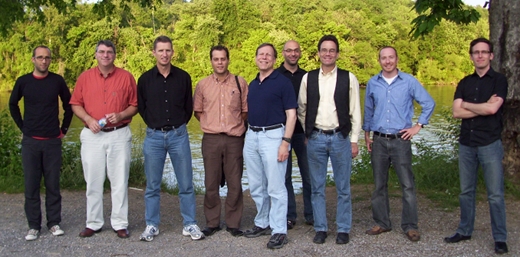 |
| Meeting 1 participants (L to R): Daniel B. Stouffer, Robert Dorazio, Richard Barker, Diego Vazquez, Steven Schwager, Stefano Allesina, Nicholas Gotelli, Joshua Ladau, Steven Kembel; (Not Pictured): Jennifer Dunne, Dan Simberloff, Edward Connor. |
NIMBioS Working Groups are chosen to focus on major scientific questions at the interface between biology and mathematics. NIMBioS is particularly interested in questions that integrate diverse fields, require synthesis at multiple scales, and/or make use of or require development of new mathematical/computational approaches. NIMBioS Working Groups are relatively small (up to 10 participants), focus on a well-defined topic, and have well-defined goals and metrics of success. Working Groups will meet up to 3 times over a two-year period, with each meeting lasting up to 2.5 days.
A goal of NIMBioS is to enhance the cadre of researchers capable of interdisciplinary efforts across mathematics and biology. As part of this goal, NIMBioS is committed to promoting diversity in all its activities. Diversity is considered in all its aspects, social and scientific, including gender, ethnicity, scientific field, career stage, geography and type of home institution. Questions regarding diversity issues should be directed to diversity@nimbios.org. You can read more about our Diversity Plan on our NIMBioS Policies web page. The NIMBioS building is fully handicapped accessible.
NIMBioS
1122 Volunteer Blvd., Suite 106
University of Tennessee
Knoxville,
TN 37996-3410
PH: (865) 974-9334
FAX: (865) 974-9461
Contact NIMBioS