| Description | Participants | Summaries | Products |
|---|
Archived NIMBioS Working Group
Ecology of Niche Variation
Topic: Population and community ecology consequences of intraspecific niche variation
Meeting dates: July 27-29, 2009; June 21-24, 2010; Febuary 10-12, 2011
Organizers:
Daniel Bolnick (Section of Integrative Biology, Univ. of Texas at Austin)
Volker Rudolf (Dept. of Ecology & Evolutionary Biology, Rice Univ.)
Kevin McCann (Dept. of Integrative Biology, Univ. of Guelph, Guelph, Ontario, Canada)
Objectives: Ecologists have long treated the trophic niche as a property of a species as a whole, implicitly assuming that individuals within a population are ecologically interchangeable. A growing body of data suggests that apparently generalist populations are, in fact, often composed of ecologically heterogeneous and relatively specialized individuals (individual specialization). The evolutionary consequences of niche variation are increasingly well understood, permitting frequency-dependent competition that can drive disruptive selection and evolutionary diversification. In contrast, very little is known about how niche variation affects the ecological dynamics of species or communities. Can ecologists safely ignore intraspecific variation?
The goal of this working group is to use mathematical models to determine whether, and how, niche variation alters the dynamics of classical models of single-species, predator-prey, and community interactions. The impact of niche variation will depend on its mechanistic basis, which can arise from quantitative genetic variation for trophic morphology, culturally transmitted foraging behaviors, search image formation, or social structure. We will bring together biologists and mathematicians familiar with 1) empirical patterns of niche variation; 2) theoretical quantitative genetics, population genetics, foraging theory, and neural networks, which can reflect the mechanisms of niche variation; and 3) mathematical models of population, predator-prey, and food web dynamics. By establishing connections between these usually separate fields, we hope to initiate a new field of mathematical ecological that melds genetics, evolution, and dynamic foraging behavior into ecological models, to determine how intraspecific variation affects ecological dynamics and community structure. Empiricists have yet to develop methods to experimentally manipulate niche variation, so at present mathematical theory is our only tool to determine the ecological effects of niche variation and make recommendations for empiricists.
Meeting Summaries
| Mtg # | Dates | Agenda | Summary | Photo | Evaluation |
|---|---|---|---|---|---|
| 1 | Jul 27-29, 2009 | Link | Link | Report | |
| 2 | Jun 21-24, 2010 | Link | Report | ||
| 3 | Feb 10-12, 2011 | Link | Report |
Meeting 1 Summary. During the first meeting, the "niche variation" working group settled on a focal question that would bind together our various sub-projects: how do the dynamics familiar ecological models change when one incorporates realistic patterns of intraspecific variation? The group assembled a list of relevant models that have been published previously and devised a strategy to split up the work of reviewing this prior literature. The group plans to write two review papers, one summarizing the relevant theoretical literature, and the second summarizing recent empirical progress in understanding the basis for why some populations exhibit more niche variation than others. Sub-groups then formulated specific models that incorporate niche variation into familiar ecological interactions, such as apparent competition, pollinator-plant dynamics, or tritrophic food chains. The group plans to analyze the dynamics of these models to determine how they behave with versus without intraspecific niche variation.
Meeting 2 Summary. This second meeting began with a review of the group's goals (to investigate how within-population trait variation alters the outcome of familiar ecological models). The remainder of the first day was spent on presentations of work in progress, including outlines of two review papers that are in preparation, and three models. The second day of the working group involved work by break-out groups focused on exploring specific models of (1) evolution of migration rates (now submitted for review), (2) quantitative genetic variance in apparent competition (close to submission), (3) size variance within species in food webs, (4) variance and interspecific competition, and (5) effects of diet variation on food chain coupling. The third day was split between a field trip to the Smoky Mountain National Park, and a large group discussion revising the outline of the main review paper (now being written for Trends in Ecology and Evolution). The final day was focused on making progress on individual and sub-group projects in break-out groups, including an extensive discussion of food web models. Between this meeting and our final (February 2011) meeting, the plan is to submit the two review papers and manuscripts on at least three of the model projects. One meeting participant is also spearheading an application for a symposium at the 2011 Ecological Society of America meeting.
Meeting 3 Summary. During this third and final meeting of the Ecology of Niche Variation Working Group, the meeting time was almost exclusively devoted to work by various small groups of people, either concluding projects initiated at previous meetings (one manuscript was revised for resubmission, another was completed), or initiating new collaborative projects. Collectively, work by the group over the past three meetings has expanded the body of theory demonstrating that within-species variation can profoundly alter population and community dynamics.
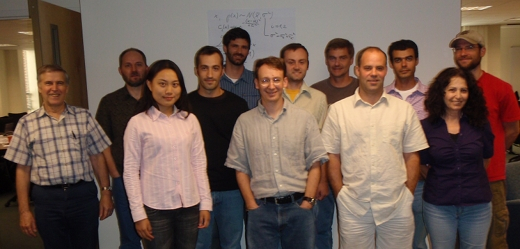 |
| (Back row, L to R): Don DeAngelis, Sebastian Schreiber, Volker Rudolf, Mark Urban, Ben Van Allen, Reinhard Bürger, Marcio Araujo, and Mark Novak; (Front row, L to R): Kelsey Jiang, Daniel Bolnick, Kevin McCann, and Gail Wolkowicz; (Not Pictured): Priyanga Amarasekare. |
NIMBioS Working Groups are chosen to focus on major scientific questions at the interface between biology and mathematics. NIMBioS is particularly interested in questions that integrate diverse fields, require synthesis at multiple scales, and/or make use of or require development of new mathematical/computational approaches. NIMBioS Working Groups are relatively small (up to 10 participants), focus on a well-defined topic, and have well-defined goals and metrics of success. Working Groups will meet up to 3 times over a two-year period, with each meeting lasting up to 2.5 days.
A goal of NIMBioS is to enhance the cadre of researchers capable of interdisciplinary efforts across mathematics and biology. As part of this goal, NIMBioS is committed to promoting diversity in all its activities. Diversity is considered in all its aspects, social and scientific, including gender, ethnicity, scientific field, career stage, geography and type of home institution. Questions regarding diversity issues should be directed to diversity@nimbios.org. You can read more about our Diversity Plan on our NIMBioS Policies web page. The NIMBioS building is fully handicapped accessible.
NIMBioS
1122 Volunteer Blvd., Suite 106
University of Tennessee
Knoxville,
TN 37996-3410
PH: (865) 974-9334
FAX: (865) 974-9461
Contact NIMBioS