| Description | Participants | Summaries | Products |
|---|
Archived NIMBioS Working Group
Multiscale Modeling of the Life Cycle of Toxoplasma gondii
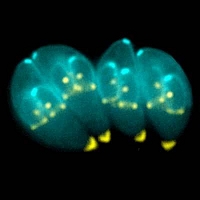
Topic: Integrated Modeling and Analysis of within-host Infection and between-host Transmission for Toxoplasma gondii
Organizers:
Zhilan Feng (Department of Mathematics, Purdue University);
Dana Mordue (Department of Microbiology and Immunology, New York Medical College);
Chunlei Su (Department of Microbiology, University of Tennessee);
Xiaopeng Zhao (Department of Biomedical Engineering, University of Tennessee)
Meeting dates: May 16-18, 2011; March 12-14, 2012; December 17-19, 2012; July 23-25, 2013
Objectives: Toxoplasma gondii (T. gondii) is considered as one of the most successful parasites for its unusual ability to infect a wide range of hosts, including mammals and birds. Up to 20% of the human population in the US and 30% in the world are chronically infected. Toxoplasma infection can cause life-threatening encephalitis in immunocompromised persons such as AIDS patients, chemotherapy patients, and organ transplant recipients. Infection acquired during pregnancy may spread and cause severe problems to the fetus, including damage to the baby's eyes and nervous system. This working group is a follow-up of a previous investigative workshop at NIMBioS (Modeling Toxoplasma gondii, May 13-15, 2010). We aim to further investigate a few important problems identified at the earlier workshop. Specifically, we will:
- develop a mathematical framework to understand within-host infection dynamics;
- explore new mathematical models to investigate the characteristics of the complex transmission pathways of T. gondii; and
- integrate within-host and between-host models to understand the influences of various properties of the parasites on their genetic diversities and bio-geographic patterns.
Results of this working group may help to develop better prevention and treatment strategies for diseases caused by T. gondii.
Meeting Summaries
| Mtg # | Dates | Agenda | Summary | Photo | Evaluation |
|---|---|---|---|---|---|
| 1 | May 16-18, 2011 | Link | Link | Report | |
| 2 | Mar 12-14, 2012 | Link | - | < | |
| 3 | Dec 17-19, 2012 | Link | - | ||
| 4 | Jul 23-25, 2013 | Link | Link |
Meeting 1 Summary. Topics discussed at the meeting focused on two subjects: between-host transmission dynamics and within-host infection dynamics. Two subgroups were formed to explore these problems. The within-host dynamics subgroup proposed several conceptual models to describe interaction of parasites with the host’s immune system. Also, a few potential approaches were suggested for chronic stage of infection. The subgroup proposed ways to link models of the two stages. The between-host transmission subgroup discussed the features available in recently developed models on T. gondii transmission and identified important biological and epidemiological questions not yet addressed. Based on these discussions, the subgroup outlined the framework of the models need to developed before the next working group meeting.
Meeting 2 summary. Topics discussed at the meeting focused on two subjects: between-host transmission dynamics and within-host infection dynamics. Two subgroups were formed to explore these problems. The between-host subgroup identified three major perspectives: 1) epidemiological dynamics of T. gondii at a large scale; 2) optimal control of the parasite in cat and rodent populations; and 3) evolutionary-ecology of the parasite. The within-host subgroup proposed ways to link models of the two stages. The between-host transmission subgroup discussed the features available in recently developed models on T. gondii transmission, and identified important biological and epidemiological questions not yet addressed. Based on these discussions, the subgroups outlined the framework of the models need to developed before the next working group meeting.
Meeting 3 summary. Topics discussed at the meeting focused on three subjects: 1) within host dynamics and its coupling to the between host dynamics; 2) epidemiology from animals to humans in different environments; and 3) evolutionary-ecology of the parasite. The group discussed a model describing cyst size distribution and proposed a first model integrating the within and between host dynamics. The group discussed the epidemiology of the parasite at the scale of cities, villages and farms and which model would be best suited to compare these different environments. The impact of humans on the evolution and ecology of the parasite was also investigated.
Meeting 4 summary. Participants at this meeting discussed several topics: 1) modeling within-host kinetics of T. gondii including invasion, replication, egress, removal, and stage conversion; 2) optimization in source allocation based on coupling between within- and between-host dynamics; and 3) evolution and epidemiology from animals to humans in different environments. The group presented a modeling framework for within-host dynamics and discussed possible in vitro and in vivo experiments to validate and parameterize the models. The group discussed the epidemiology of the parasite at the scale of cities, villages and farms and which model would be best suited to compare these different environments. The impact of humans on the evolution and ecology of the parasite was also investigated.
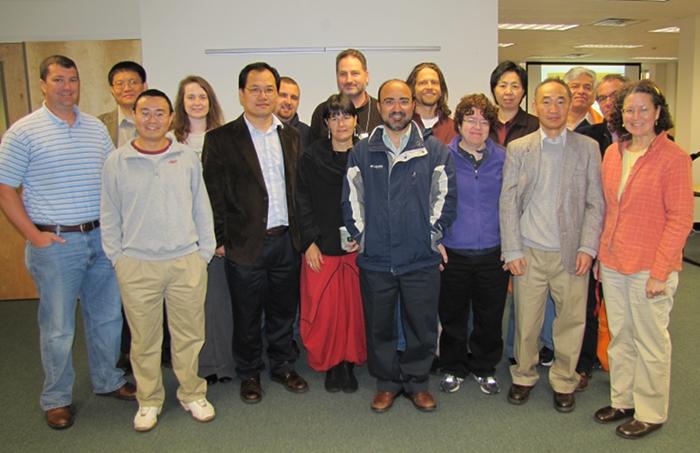 |
| Meeting 1 participants (Back row, L to R): Chunlei Su, Virginia Pasour, Adam Sullivan, Benjamin Rosenthal, Michael Gilchrist, Zhilan Feng, Jorge Velasco-Hernandez, Michel Langlais; (Front row, L to R): Matt Turner, Dashun Xu, Xiaopeng Zhao, Emmanuelle Gilot-Fromont, Gustavo Arrizabalaga, Dana Mordue, Yasuhiro Suzuki, Suzanne Lenhart |
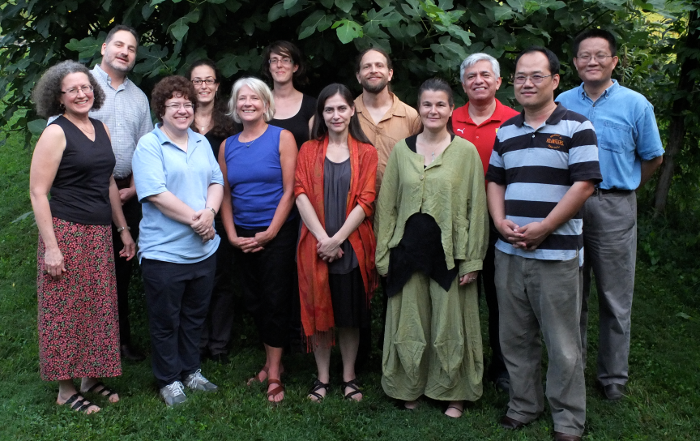 |
| Meeting 4 participants (Back row, L to R): Benjamin Rosenthal, Cecile Gotteland, Maud Lelu, Michael Gilchrist, Jorge Velasco-Hernandez, Chunlei Su; (Front row, L to R): Suzanne Lenhart, Dana Mordue, Sandra Halonen, Claudia Munoz-Zanzi, Emmanuelle Gilot-Fromot, Xiaopeng Zhao. Not pictured: Gustavo Arrizabalaga. |
NIMBioS Working Groups are chosen to focus on major scientific questions at the interface between biology and mathematics. NIMBioS is particularly interested in questions that integrate diverse fields, require synthesis at multiple scales, and/or make use of or require development of new mathematical/computational approaches. NIMBioS Working Groups are relatively small (up to 10 participants), focus on a well-defined topic, and have well-defined goals and metrics of success. Working Groups will meet up to 3 times over a two-year period, with each meeting lasting up to 2.5 days.
A goal of NIMBioS is to enhance the cadre of researchers capable of interdisciplinary efforts across mathematics and biology. As part of this goal, NIMBioS is committed to promoting diversity in all its activities. Diversity is considered in all its aspects, social and scientific, including gender, ethnicity, scientific field, career stage, geography and type of home institution. Questions regarding diversity issues should be directed to diversity@nimbios.org. You can read more about our Diversity Plan on our NIMBioS Policies web page. The NIMBioS building is fully handicapped accessible.
NIMBioS
1122 Volunteer Blvd., Suite 106
University of Tennessee
Knoxville,
TN 37996-3410
PH: (865) 974-9334
FAX: (865) 974-9461
Contact NIMBioS