| Description | Participants | Summaries | Products |
|---|
Archived NIMBioS Working Group
Multi-scale Analysis of Cortical Networks
Topic: Working Group on Multi-scale analysis of cortical networks
Meeting dates: May 19-21, 2010; May 9-11, 2011
Organizers:
A. Ravishankar Rao (IBM Research);
Ehud Kaplan (Mt. Sinai School of Medicine)
Objectives: We present the use of statistical network theory as a unifying mathematical model that enables the analysis of neuroscientific data across multiple levels of abstraction, ranging from single neuron to whole brain. There are three basic steps in our approach. The first is to convert the cortical spatio-temporal measurements into a functional graph-based representation, where the nodes are cortical elements, and the edges represent correlations or other specific relations such as causality between their activities. The second step extracts basic network properties based on building blocks called motifs. The third step examines properties of the network as characterized by the distribution of motifs. We will analyze the differences in motifs as a function of the state of the subject and the task being performed. This analysis will allow us to determine whether functional network features can be used as bio-markers of the state of the brain. This may prove useful in distinguishing diseased brains from normal ones, such as in the case of Alzheimer's.
There are numerous mathematical modeling challenges, such as designing the optimal technique to construct a functional network from a set of spatio-temporal cortical measurements, determining the best network characterization technique that is robust to experimental conditions such as noise, and understanding the structure-function relationships in the derived networks.
The Working Group is composed of researchers with a wide range of backgrounds, ranging from mathematical physics, through computer science to neuroscience. This group is uniquely positioned to address this challenging task, including the computational processing of massive amounts of data that are typical for such neuroscientific investigations.
Meeting Summaries
| Mtg # | Dates | Agenda | Summary | Photo | Evaluation |
|---|---|---|---|---|---|
| 1 | May 19-21, 2010 | Link | Link | Report | |
| 2 | May 9-11, 2011 | Link | Link |
Meeting 1 Summary. Due to the complexity of the biological system being studied, the brain, a significant portion of the meeting was devoted to understanding current theoretical and experimental research. The experimentalists provided detailed reports of recording techniques and neural behavior across multiple brain areas at different levels of abstraction. Mechanisms for coding and generation of stimulus responses were examined. A novel aspect that emerged from the presentations of the experimentalists is that the representation of the external world in the brain may not be as highly compartmentalized into specific functional areas as is widely thought. Rather, representations are distributed widely across the brain. The theoreticians and computational modelers presented models of cortical function where the interactions between neural units were determined by properties of the networks that connected these units. Techniques for the computation of causal relationships from multivariate neural data were also discussed as were the dynamics of a network of interconnected neurons. The main finding from the presentations of the theoreticians is that the structure and evolution of the network determine its function. The experimentalists have agreed to make some of their data available to the theoreticians so that network analysis techniques can be applied to these data. The group also plans to design an appropriate experiment to test the communication between different cortical areas. The next meeting is planned for fall 2010.
Meeting 2 Summary. This meeting focused on the two goals of writing a perspective paper and submitting an NSF/NIH Center Grant proposal. The perspective paper will use our unique expertise to delineate major challenges and trends in analyzing cortical networks. The target audience consists of neuroscientists, graduate students, decision-makers in funding agencies, and those scientists outside the field who are looking for significant problems to address. Specific questions the paper will address include the following. How do we probe and measure networks? What should we measure, and what are the theoretical considerations that dictate our measurements? How do we interpret the activity of an ensemble of neurons? The paper will also address challenges facing investigators, such as obtaining longer duration multi-electrode recordings, better data processing, and a data sharing. The Group plans to submit the perspective paper to a journal by December 2011. Regarding the Center Grant idea, the activity of our group can help shape a proposal to physics in NSF, where they are already investigating the creation of a center where experimentalists, post-docs and other researchers can work synergistically together. The next meeting is planned for the first quarter of 2012.
Final Report, June 2013. The Cortical Networks Working Group created a Special Topics Issue with the open access journal, Frontiers of Neuroscience. The call for papers was drafted by three members of this group, A. Ravishankar Rao, G.A. Cecchi and E. Kaplan. The core ideas presented in the vision for this issue were debated during our meetings in 2010 and 2011. The website for the Special Topics Issue is HERE. This issue will be published as an eBook by December 2013.
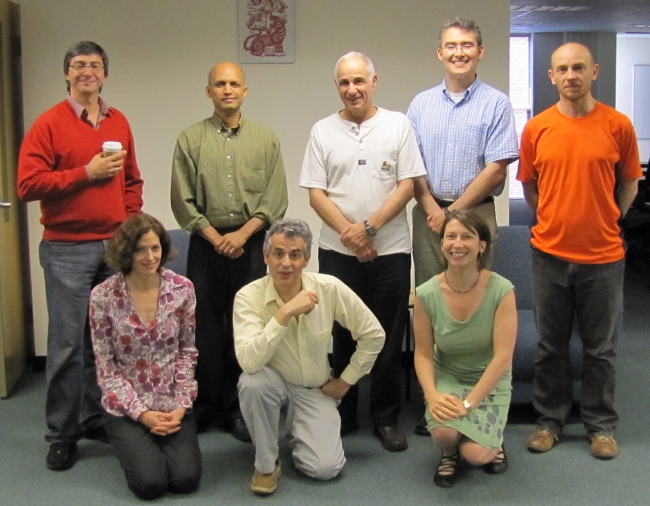 |
| Meeting 1 participants (Back row: L to R): Dario Ringach, Ravi Rao, Ehud Kaplan, John Beggs, Guillermo Cecchi; (Front row, L to R): Judith Hirsch, Marcelo Magnasco, Maria Neimark-Geffen. |
NIMBioS Working Groups are chosen to focus on major scientific questions at the interface between biology and mathematics. NIMBioS is particularly interested in questions that integrate diverse fields, require synthesis at multiple scales, and/or make use of or require development of new mathematical/computational approaches. NIMBioS Working Groups are relatively small (up to 10 participants), focus on a well-defined topic, and have well-defined goals and metrics of success. Working Groups will meet up to 3 times over a two-year period, with each meeting lasting up to 2.5 days.
A goal of NIMBioS is to enhance the cadre of researchers capable of interdisciplinary efforts across mathematics and biology. As part of this goal, NIMBioS is committed to promoting diversity in all its activities. Diversity is considered in all its aspects, social and scientific, including gender, ethnicity, scientific field, career stage, geography and type of home institution. Questions regarding diversity issues should be directed to diversity@nimbios.org. You can read more about our Diversity Plan on our NIMBioS Policies web page. The NIMBioS building is fully handicapped accessible.
NIMBioS
1122 Volunteer Blvd., Suite 106
University of Tennessee
Knoxville,
TN 37996-3410
PH: (865) 974-9334
FAX: (865) 974-9461
Contact NIMBioS