
High School Scholars Visit NIMBioS

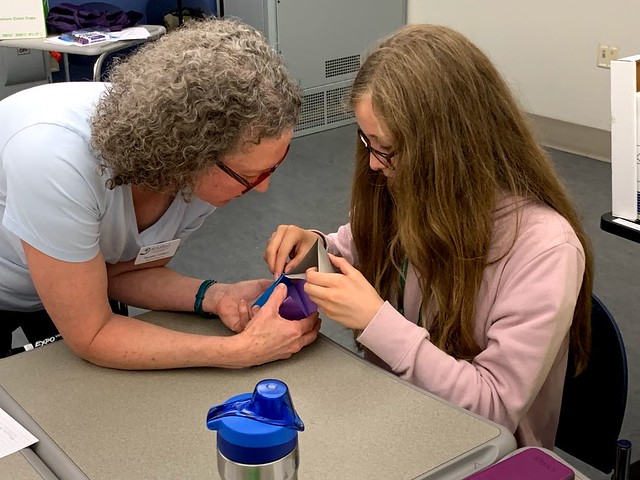
Two Tennessee high school students mix beans in a cup to simulate the outbreak of a disease during their visit to NIMBioS.

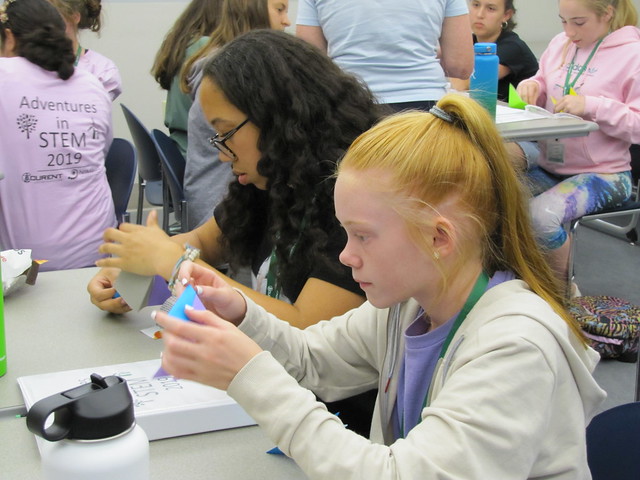
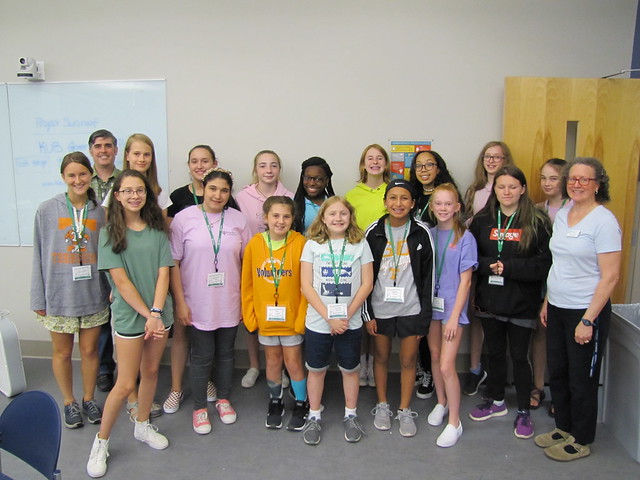
Tennessee high school students visited NIMBioS last week as a part of the annual Tennessee Junior Science and Humanties Symposium. Suzanne Lenhart, NIMBioS associate director for education, outreach and diversity, spoke to the students and their teacher sponsors about how NIMBioS researchers apply mathematics to solving some of today’s biggest biological questions, including how to manage and control diseases. A hands-on activity called “Outbreak in a Cup,” led by Kelly Sturner, NIMBioS education and outreach coordinator, generated discussion of important components in a disease model. Jennifer Richards, from Hands On and a NIMBioS collaborator, introduced students to data visualization software called Gapminder and led the students in exploring data on malaria around the world. The symposium gave students the opportunity to present their own original scientific research in a public forum, compete for scholarships, and tour labs and facilities on the UT-Knoxville campus and Oak Ridge National Laboratory.


Did you like this? Share it:
Posted in Education/Outreach | Tagged | Leave a comment

The Story of a Scientific Collaboration: How One Nature Paper Came to Be

Dr. Tony Jhwueng (left) and Dr. R. Tucker Gilman (right)

Having a few linear algebraists as co-workers can come in handy — especially near Halloween — when one is stuck on a knotty mathematical biology problem with no clear solution.

This proved to be the case for NIMBioS postdoctoral fellow Tucker Gilman while he was working on a mathematical model to describe coevolution in multidimensional trait space, which has just been published in Nature. It all transpired on one night near Halloween in 2010.

Gilman began working on the problem with his colleague Scott Nuismer at the University of Idaho when Gilman began his postdoc at NIMBioS in the fall of 2010.

“The original plan was to look at two- and possibly three-dimensional systems,” Gilman said. “When we had done the math for two and three dimensions, there was a clear pattern that looked like it would hold for any number of dimensions. This was an opportunity to take the project from the ‘we found something cool in some models’ level to the ‘we discovered something fundamental about the way nature works’ level.”

But then the research team hit a mathematical roadblock: They could demonstrate numerically that the pattern was almost certainly correct, but could not prove the pattern absolutely. In efforts to find the answer, Gilman, an evolutionary biologist by training, talked to numerous math professors and consulted mathematical texts, but to no avail. “I had run into one of those situations where mathematical intuition is not a substitute for mathematical training. I was stuck,” he said.

NIMBioS colleagues to the rescue.

NIMBioS postdocs and visiting scientists not only work together but also often socialize, and that was the case near Halloween in 2010. Gilman, along with former NIMBioS postdocs Tony Jhwueng, Folashade Agusto, and visiting scientist Dave McCandlish from Duke University, visited a corn maze for some pre-Halloween fun.

“The ride back was about half an hour long, and I noticed I had three really good linear algebraists in a captive audience,” Gilman explained. “I described the pattern I had seen, and asked them how I might prove it would always hold. We threw some ideas around, but really didn’t make much progress. At least, I didn’t think we had.”

But on Monday morning, Jhwueng, now an assistant professor in statistics at Feng-Chia University in Taichung, Taiwan, had some news for Gilman.

“Tony showed up in my office with a formal proof of the pattern we had talked about,” Gilman said. “It was exactly what we needed to go forward. That was the start of the collaboration. After that, Tony fixed another proof Scott and I were stuck on, and checked the ones I had been able to do myself.”

And so together, Gilman, Nuismer and Jhwueng went on to write the paper and got it accepted for publication at Nature. “I am sure we would have gotten the paper published without the collaboration, but probably not in Nature,” Gilman surmised.

Postdoctoral applications at NIMBioS are reviewed three times per year — March 1, Sept. 1, Dec. 11. Selected researchers are offered positions at NIMBioS where they conduct research that is mostly self-directed. For more information about how to apply, visit http://www.nimbios.org/postdocs


Did you like this? Share it:
Posted in ecology, postdocs, publication, research | Tagged , , , | Leave a comment

NIMBioS Responds to the Googleopoly

While the Google Empire rolls out controversial changes to its privacy rules today that track users across multiple services, NIMBioS also makes some changes of its own with regard to privacy and usage of our web site — changes that we hope might protect your search habits.

New default settings on Google now allow it to collect and cross-reference a logged-in user’s activity on Google-owned sites on the Internet, such Gmail, YouTube, Google docs, Google maps and of course its sophisticated search engine. It also affects smartphones that run on Google’s Android software.

The changes also give Google permission to share its information with other sites.

At NIMBioS, we use Google Analytics to gather and analyze statistics related to use of our web site, including traffic volumes, operating systems, browser types and screen resolutions. We use this information to monitor and assess the effectiveness and accessibility of our web pages. Google Analytics allows web site owners to opt out of sharing data with other sites, and so we have chosen to do so. Therefore, on the NIMBioS web site, Google Analytics will exclude these data from any automated processes that are not specifically related to operating and improving Google Analytics or protecting the security and integrity of the data.

Google says its new privacy policy will help to streamline a user’s Internet experience, tailoring advertisements based on the user’s activity. However, privacy-protection groups and consumer advocates contend that Google is going too far, gathering too much personal data and sending it to other sites, without a person’s explicit consent.

Respecting our users’ privacy, we at NIMBioS think we have taken the necessary steps to continue to assure some measure of privacy. You can read more about our Privacy Policy and other NIMBioS policies at http://www.nimbios.org/governance/policies.

Did you like this? Share it:
Posted in Computing | Leave a comment

Lande Visits NIMBioS

Russell Lande (center, black shirt) visits with NIMBioS postdocs (from left) JJ Chai, Tom Ingersoll, Andrew Kanarek, Maud Lélu, Xavier Thibert-Plante, Dan Ryan, Orou Gaoue and Gesham Magombedze

Distinguished theoretical biologist Russell Lande visited NIMBioS yesterday and gave a seminar talk on the topic of phenotypic plasticity. Lande’s talk, “Adaptation to an extraordinary environment by evolution of phenotypic plasticity and genetic assimilation,” filled a packed classroom. Lande was a NIMBioS Postdoctoral Fellows Invited Distinguished Visitor. A Royal Society Research Professor in Natural Sciences at Imperial College London, Lande has won numerous awards for his work, including a MacArthur Fellowship and most recently the Balzan Prize for Theoretical Biology or Bioinformatics, for “pioneering contributions to the development and application of theoretical population biology, including the modern development of the theory of quantitative genetics, and the study of stochastic population dynamics.” For more information on NIMBioS seminars, visit http://www.nimbios.org/announcements/seminar_calendar.

Did you like this? Share it:
Posted in postdocs, seminars | Tagged , | Leave a comment

Ngonghala Presents the Buzz on Mosquitos and Malaria

NIMBioS Postdoc Calistus Ngonghala (center, red tie) poses after his talk with a group of Howard University students and faculty

NIMBioS Postdoctoral Fellow Calistus Ngonghala shared his research in modeling mosquito transmission of malaria at Howard University earlier this month. His talk, titled “The role of mosquito demography and nourishment habits on the dynamics of malaria transmission,” was presented to a group of faculty, undergraduate and graduate students during his visit to Washington, DC. By including mosquito population dynamics into his malaria disease model, the model captures natural fluctuations and oscillations known to prevail in malaria dynamics that are hard to attribute to external forcing factors.

Did you like this? Share it:
Posted in ecology, Education/Outreach, postdocs, research | Tagged , , , , , , | Leave a comment

Botesteanu Wins MAA Outstanding Presentation Award

Dana-Adriana Botesteanu, 2011 NIMBioS REU Participant

Dana-Adriana Botesteanu, a participant in NIMBioS’ 2011 REU program, has won an “Outstanding Presentation” award from the Mathematical Association of America for her poster at the Undergraduate Poster Session at the 2012 Joint Mathematics Meetings. Botesteanu’s poster presentation, “How does the effort that a mother bird expends on her offspring depend on the attractiveness of her mate?” was rated within the top 15% of more than 300 posters. The research stemmed from Botesteanu’s research at NIMBioS during the REU program. Botesteanu, a mathematics and French major at Mount Holyoke College, describes her research in this NIMBioS video about REU. Mentors for the team project were Dr. Tucker Gilman, a current NIMBioS postdoctoral fellow, and Dr. Tony Jhwueng, former  postdoctoral fellow at NIMBioS. Other 2012 winners are listed here. Congratulations, Dana!

Did you like this? Share it:
Posted in awards, ecology, Education/Outreach, research, REU/REV, undergraduates, Wildlife | Tagged , , , , , | Leave a comment

Happy Birthday, Darwin! NIMBioS Celebrates at Teacher Workshop

Teachers work together on activities and discuss the challenges and strategies for teaching evolution in their classrooms at the Darwin Day Teacher Workshop.

In honor of Charles Darwin’s birthday last week, NIMBioS participated in a training-the-teacher workshop on strategies for teaching evolution for around 30 local middle and high school teachers in East Tennessee. NIMBioS Education & Outreach Coordinator Kelly Sturner led teachers in an activity demonstrating how half-life and radiometric dating helps scientists determine the absolute age of fossils in rock layers, a major source of evidence for evolution. The activity came from Biology in a Box, and the workshop was a part of UT-Knoxville’s week-long celebration of Darwin Day organised by volunteers from the Ecology and Evolutionary Biology Department.

Did you like this? Share it:
Posted in Education/Outreach, STEM, Workshop | Tagged , , | Leave a comment

The Noes Have It

Following a lively public debate on the role of warfare in early social evolution, a sea of hands waving blue cards with the words “anti-thesis” indicated that the majority of the audience believed the antithesis debaters had won the day: that is, other evolutionary mechanisms, and not warfare alone, hastened the rise of highly complex societies.

The debate, held Feb. 8, 2012, in the University of Tennessee’s University Center, was designed to raise questions about how science can explain the transition from simple to complex societies.

To find out more about the debate and a link to view it, click here.

Did you like this? Share it:
Posted in Education/Outreach, Workshop | Tagged , | Leave a comment

SFI President Brings Anthropologist’s Perspective

Mathematical modelers, anthropologists, archaeologists, and other social scientists are gathered at NIMBioS this week for the Investigative Workshop on Modeling Social Complexity. The aim of the workshop, co-hosted by NIMBioS and the National Evolutionary Synthesis Center, is to work toward developing a formal theory for the evolution of human social complexity. This new science, known as Cliodynamics, uses a dynamical systems approach to studying history by combining mathematical models and analyses of quantitative data to explain the processes and mechanisms that influence history. This week’s gathering of international scholars looking mathematical modeling of social complexity is the first of its kind. One participant is Dr. Jeremy Sabloff, the president of Santa Fe Institute. We sat down with Dr. Sabloff, an anthropologist, to find out the value of mathematical approaches to scientific inquiry. Click here to view the video.

Did you like this? Share it:
Posted in video, Workshop | Tagged , | Leave a comment

It’s in Your Genes: Tree Diagrams, Probability, & Inheritance

Source: capl@washjeff.edu

Our latest post over at Biology by Numbers on Talking Science teaches a lesson in genetics. Poker chips are used not for gambling but to represent genes. In this lesson, borrowed with permission from Biology in a Box, students draw tree diagrams to illustrate the chance for inheritance of multiple traits.  In this hands-on activity, students use the chips to simulate the inheritance of multiple traits by an offspring produced by a cross between parents of randomly determined genotypes. The lesson is geared toward 9th-12th grade levels and covers the subjects of genetics, probability and mathematics. More Biology by Numbers posts can be found at the Talking Science website. Talking Science is a project of the radio program NPR’s Science Friday.

Did you like this? Share it:
Posted in Education/Outreach, TalkingScience | Tagged | Leave a comment